Differentiating Vector Fields on Manifolds
Affine Connections
Notion of derivative for vector fields on manifolds is called a connection , traditionally denoted by $\nabla$ ("nabla").
Given a tangent vector $u \in T_x\mathcal{M}$ and a vector field $V$, $\nabla_uV$ is the derivative of $V$ at $x$ along $u$.
Formally, we should write $\nabla_{(x,u)} V$ where the base point $x$ is typically clear from context.
Note that we do not need a Riemannian metric yet.
Definition 1. A connection on a manifold $M$ is an operator
$$\nabla \colon \operatorname{T}_{}{\mathcal{M}} \times \mathfrak{X}(\mathcal{M}) \to \operatorname{T}_{}{\mathcal{M}}: (u, V) \mapsto \nabla_u V$$where:
-
$\operatorname{T}_{}{\mathcal{M}}$ is the tangent vector space
-
$\mathfrak{X}(\mathcal{M})$ denotes smooth vector fields on $\mathcal{M}$
This operator must satisfy four properties for all $u,w \in \operatorname{T}_{}{\mathcal{M}}$, $U,V,W \in \mathfrak{X}(\mathcal{M})$, $a,b \in \mathbb{R}$, and $f \in C^\infty(\mathcal{M})$:
-
Smoothness: $(\nabla_UV)(x) \stackrel{\Delta}{=}\nabla_{U(x)}V$ defines a smooth vector field $\nabla_UV$;
-
Linearity in $u$: $\nabla_{au + bw}V = a\nabla_uV + b\nabla_wV$;
-
Linearity in $V$: $\nabla_u(aV + bW) = a\nabla_uV + b\nabla_uW$;
-
Leibniz rule: $\nabla_u(fV) = \operatorname{D}{f}(x)[u]\cdot V(x) + f(x)\nabla_{u}{V}$.
The field $\nabla_U V$ is called the covariant derivative of $V$ along $U$ with respect to $\nabla$.
Theorem 2. Let $\mathcal{M}$ be an embedded submanifold of a Euclidean space $\mathcal{E}$. The operator $\nabla$ defined by
$$\nabla_{u}{V} = \operatorname{Proj}_{x} {\left(\operatorname{D}{\bar V}(x)[u]\right)} \tag{Eq. 1}$$is a connection on $\mathcal{M}$, where $\operatorname{Proj}_{x}$ is the projector from $\mathcal{E}$ to the tangent vector space $\operatorname{T} _x(\mathcal{M})$.
Proof. Let $\mathcal{M}$ be an embedded submanifold of a Euclidean space $\mathcal{E}$ by $\bar \nabla$. Then
$$\nabla_u V = \operatorname{Proj}_{x} {\left(\operatorname{D}{\bar V}(x)[u]\right)} = \operatorname{Proj}_{x} {\left(\bar\nabla_{u}{\bar V}\right)}.$$Projection is a linear operation which maintains the properties (linearities of $u, V$) of connections $\nabla_u V$, hence $\operatorname{Proj}_{x} {\left(\operatorname{D}{\bar V}(x)[u]\right)}$ is a connection on $\mathcal{M}$.
- If $M$ is a submanifold of $\mathcal{E}$, the claim is clear since $\operatorname{Proj}_x$ is identity and we can take $\bar V = V$.
- Suppose $M$ is a manifold not open in $\mathcal{E}$. Consider $U,V,W \in \mathfrak{X}(\mathcal{M})$ together with smooth extensions $\bar U, \bar V, \bar W \in \mathfrak{X}(O)$ defined on a neighborhood $O$ of $\mathcal{M}$. $\bar \nabla$ is a connection on $O$ since $O$ is an open submanifold of $E$. Consider $a, b \in \mathbb{R}$ and $u, w\in \operatorname{T} _x \mathcal{M}$. Then,
- Since projection is a linear operation, $\nabla _u V = \operatorname{Proj} _{x} {\left(\bar\nabla _{u}{\bar V}\right)}$ is a smooth vector field;
- $$\begin{aligned}\nabla _{au+bw} V &= \operatorname{Proj}_x (\bar \nabla _{au+bw} \bar V) \\ &= \operatorname{Proj}_x (a\bar \nabla _{u} \bar V + b \bar \nabla _{w} \bar V) \\ &= a \nabla _{u} V + b \nabla _{w} V \end{aligned}$$
- $$\begin{aligned}\nabla _{u} (aV+bW) &= \operatorname{Proj}_x \left(\bar \nabla _{u} (a\bar V+b\bar W)\right) \\ &= \operatorname{Proj}_x (a\bar \nabla _{u} \bar V + b \bar \nabla _{u} \bar W) \\ &= a \nabla _{u} V + b \nabla _{u} W \end{aligned}$$
- To verify the Leibniz rule, consider an arbitrary $f\in \mathfrak{F}(\mathcal{M})$ and smooth extension $\bar f \in \mathfrak{F}(O)$. $$\begin{aligned}\nabla _{u} (fV) &= \operatorname{Proj}_x \left(\bar \nabla _{u} (\bar f \bar V)\right) \\ &= \operatorname{Proj}_x (\operatorname{D} \bar f (x) [u] \cdot \bar V(x) + \bar f(x) \bar \nabla _{u} \bar V) \\ &= \operatorname{D} f (x) [u] \cdot V(x) + f(x) \nabla _{u} V \end{aligned}$$ Hence, $\nabla _{U} V$ with $\nabla _{u} V= \operatorname{Proj} _{x} {\left(\operatorname{D}{\bar V}(x)[u]\right)}$ is a connection on $\mathcal{M}$.
$\square$
Proposition 3. Let $\mathcal{M}$ be a manifold with arbitrary connection $\nabla$. Given a smooth vector field $V \in \mathfrak{X}(\mathcal{M})$ and a point $x \in \mathcal{M}$, if $V(x) = 0$ then $\nabla_u V=\operatorname{D}{V}(x)[u]$ for all $u\in \operatorname{T}_{x}{\mathcal{M}}$. In particular, $\operatorname{D}{V}(x)[u]$ is tangent at $x$.
Proof. Expand $V$ in a local frame $W_1,\cdots, W_n \in \mathfrak{X}(\mathcal{U})$ on some neighborhood $\mathcal{U}$ of $x$ on $\mathcal{M}$, i.e.
$$V \mid _{\mathcal{U}} = g_1 W_1 + \cdots + g_n W_n$$where $g_1,\cdots, g_n: \mathcal{U}\to \mathbb{R}$ are smooth. Given $u \in \operatorname{T} _{x}\mathcal{M}$, then we have
$$\nabla _u V = \nabla _u (V\mid_{\mathcal{U}}) = \sum\limits_{i=1}^n \nabla _u (g_iW_i) = \sum\limits_{i=1}^n \operatorname{D} g_i(x)[u]\cdot W_i(x) + g_i(x) \nabla _u W_i \tag{Eq. 2}$$and
$$\operatorname{D} V(x)[u] = \sum\limits_{i=1}^n \operatorname{D} (g_iW_i)(x)[u] = \sum\limits_{i=1}^n \operatorname{D} g_i(x)[u]\cdot W_i(x) + g_i(x) \operatorname{D} W_i(x)[u] \tag{Eq. 3}$$where $V(x) = 0$ implies $\forall 1\le i\le n, g_i(x) = 0$. Thus, if $V(x) = 0$, then
$$\nabla _u V = \sum\limits_{i=1}^n \operatorname{D} g_i(x)[u]\cdot W_i(x) = \operatorname{D} V(x)[u].$$$\square$
Riemannian Connections
Definition 4. For $U, V \in \mathfrak{X}(\mathcal{M})$ and $f \in \mathfrak{F}(\mathcal{U})$ with $\mathcal{U}$ open in $\mathcal{M}$, define:
-
$Uf \in \mathfrak{F}(\mathcal{U})$ such that $(Uf)(x) = \operatorname{D} f(x)[U(x)]$;
-
$[U, V]: \mathfrak{F}(\mathcal{U})\to \mathfrak{F}(\mathcal{U})$ such that $[U,V]f = U(Vf) - V(Uf)$;
-
$\langle U, V\rangle \in \mathfrak{F}(\mathcal{M})$ such that $\langle U, V\rangle(x) = \langle U(x), V(x)\rangle _x$.
The notation $Uf$ captures the action of a smooth vector field $U$ on a smooth function $f$ through derivation, transforming $f$ into another smooth function. The commutator $[U,V]$ of such action is called the Lie bracket. Even in linear spaces $[U, V ]f$ is nonzero in general. Notice that $Uf = \langle \operatorname{grad}f, U\rangle$ owing to the definitions of $Uf, \langle V, U\rangle$ and $\operatorname{grad} f$.
Theorem 5. On a Riemannian manifold $\mathcal{M}$, there exists a unique connection $\nabla$ which satisfies two additional properties for all $U,V,W \in \mathfrak{X}(\mathcal{M})$:
-
Symmetry: $[U, V] f = (\nabla_{U}{V} -\nabla_{V}{U}) f$ for all $f \in \mathfrak{F}(\mathcal{M})$;
-
Compatibility with the metric: $U\langle V,W\rangle = \langle\nabla_{U}{V},W\rangle+\langle V,\nabla_{U}{W}\rangle$.
This connection is called the Levi-Civita or Riemannian connection.
Theorem 6. The Riemannian connection on a Euclidean space $\mathcal{E}$ with any Euclidean metric $\langle \cdot, \cdot \rangle$ is $\nabla_{u}{V} = \operatorname{D}{V}(x)[u]$: the canonical Euclidean connection.
Theorem 7. Let $\mathcal{M}$ be an embedded submanifold of a Euclidean space $\mathcal{E}$. The connection $\nabla_{}{}$ defined by Eq. 1 is symmetric on $\mathcal{M}$.
Proof. We first establish compatibility with the metric, as it will be useful to prove symmetry. Consider three vector fields $U,V,W\in\mathfrak{X}(\mathcal{E})$. Owing to smoothness of the latter and to the definition of $\nabla$,
$$\begin{aligned} V(x+tU(x))&=V(x)+t\operatorname{D} V(x)[U(x)]+O(t^2)\\&=V(x)+t(\nabla_U V)(x)+O(t^2).\end{aligned}$$Define the function $f=\langle V,W\rangle$. Using bilinearity of the metric,
$$\begin{aligned} (Uf)(x)&=\operatorname{D} f(x)[U(x)]\\ &=\lim_{t\rightarrow 0}\frac{\langle V(x+tU(x)),W(x+tU(x))\rangle-\langle V(x),W(x)\rangle}{t}\\ &=\lim_{t\rightarrow 0}\frac{\langle V(x)+t(\nabla_U V)(x),W(x)+t(\nabla_U W)(x)\rangle-\langle V(x),W(x)\rangle}{t}\\ &=(\langle\nabla_U V,W\rangle+\langle V,\nabla_U W\rangle)(x)\end{aligned}$$for all $x$, as desired. To establish symmetry, we develop the left-hand side first. Recall the definition of Lie bracket: $[U,V]f=U(Vf)-V(Uf)$. Focusing on the first term, note that
$$(Vf)(x)=\operatorname{D} f(x)[V(x)]=\langle \text{grad}f(x),V(x)\rangle _{x}.$$We can now use compatibility with the metric:
$$U(Vf)=U\langle \text{grad}f,V\rangle=\langle\nabla_{U}(\text{grad}f),V\rangle+\langle \text{grad}f,\nabla_{U}V\rangle.$$Consider the term $\nabla_{U}(\text{grad}f)$: this is the derivative of the gradient vector field of $f$ along $U$. By definition, this is the (Euclidean) Hessian of $f$ along $U$. We write $\nabla_{U}(\text{grad}f)=\text{Hess}f[U]$, with the understanding that $(\text{Hess}f[U])(x)=\text{Hess}f(x)[U(x)]=\nabla_{U(x)}(\text{grad}f)$. Overall,
$$U(Vf)=\langle \text{Hess}f[U],V\rangle+\langle \text{grad}f,\nabla_{U}V\rangle.$$Likewise for the other term,
$$V(Uf)=\langle \text{Hess}f[V],U\rangle+\langle \text{grad}f,\nabla_{V}U\rangle.$$It is a standard fact from multivariate calculus that the Euclidean Hessian is self-adjoint, that is, $\langle \text{Hess}f[U],V\rangle=\langle \text{Hess}f[V],U\rangle$. (This is the Clairaut-Schwarz theorem, which you may remember as the fact that partial derivatives in $\mathbb{R}^{n}$ commute.) Hence,
$$\begin{aligned}[U,V]f&=U(Vf)-V(Uf)\\ &=\langle \text{grad}f,\nabla_U V-\nabla_V U\rangle\\ &=(\nabla_U V-\nabla_V U)f.\end{aligned}$$$\square$
Theorem 8. Let $M$ be a Riemannian submanifold of a Euclidean space. The connection $\nabla_{}{}$ defined by Eq. 1 is the Riemannian connection on $\mathcal{M}$.
Proof. Let $\bar{\nabla}$ denote the canonical Euclidean connection on $\mathcal{E}$. If $\mathcal{M}$ is an open submanifold of $\mathcal{E}$, the claim is clear since $\nabla$ is then nothing but $\bar{\nabla}$ with restricted domains. We now consider $\mathcal{M}$ not open in $\mathcal{E}$. To establish symmetry of $\nabla$, we rely heavily on the fact that $\bar{\nabla}$ is itself symmetric on (any open subset of) the embedding space $\mathcal{E}$. Consider $U,V\in\mathfrak{X}(\mathcal{M})$ and $f\in\mathfrak{F}(\mathcal{M})$ together with smooth extensions $\bar{U},\bar{V}\in\mathfrak{X}(O)$ and $\bar{f}\in\mathfrak{F}(O)$ to a neighborhood $O$ of $\mathcal{M}$ in $\mathcal{E}$. We use the identity $Uf = (\bar{U}\bar{f})|_{\mathcal{M}}$ repeatedly, then the fact that $\bar{\nabla}$ is symmetric on $O$:
$$\begin{aligned}[U,V]f &= U(Vf) - V(Uf)\\ &= U((\bar{V}\bar{f})|_{\mathcal{M}}) - V((\bar{U}\bar{f})|_{\mathcal{M}})\\ &= (\bar{U}(\bar{V}\bar{f}))|_{\mathcal{M}} - (\bar{V}(\bar{U}\bar{f}))|_{\mathcal{M}}\\ &= ([\bar{U},\bar{V}]\bar{f})|_{\mathcal{M}}\\ &= ((\bar{\nabla}_{\bar{U}}\bar{V}-\bar{\nabla}_{\bar{V}}\bar{U})\bar{f})|_{\mathcal{M}}\\ &= (\bar{W}\bar{f})|_{\mathcal{M}}, \end{aligned} \tag{Eq. 4}$$where we defined $\bar{W}=\bar\nabla _{\bar{U}} \bar{V} - \bar\nabla _{\bar{V}} \bar{U} \in \mathfrak{X}(O)$. The individual vector fields $\bar{\nabla} _{\bar{U}} \bar{V}$ and $\bar{\nabla} _{\bar{V}} \bar{U}$ need not be tangent along $\mathcal{M}$. Assume $\bar{W}$ is a smooth extension of a vector field $W$ on $\mathcal{M}$. Then,
$$ W = \bar{W}|_{\mathcal{M}} = \text{Proj}(\bar W) = \text{Proj}(\bar{\nabla}_{\bar{U}}\bar{V}-\bar{\nabla}_{\bar{V}}\bar{U}) = \nabla_U V - \nabla_V U.$$Furthermore, $(\bar{W}\bar{f})| _{\mathcal{M}} = Wf$, so that continuing from Eq. 4 we find:
$$ [U,V]f = (\bar{W}\bar{f})|_{\mathcal{M}} = Wf = (\nabla_U V - \nabla_V U)f, $$which is exactly what we want. Thus, it only remains to show that $\bar{W}(x)$ is indeed tangent to $\mathcal{M}$ for all $x\in\mathcal{M}$. To this end, let $x\in\mathcal{M}$ be arbitrary and let $\bar{h}:O’\to\mathbb{R}^k$ be a local defining function for $\mathcal{M}$ around $x$ so that $\mathcal{M}\cap O’=\bar{h}^{-1}(0)$, and we ensure $O’\subseteq O$. Consider the restriction $h=\bar{h}| _{\mathcal{M}\cap O’}$: of course, $h$ is nothing but the zero function. Applying (5.9) to $h$, we find:
$$ 0=[U,V]h=(\bar{W}\bar{h})|_{\mathcal{M}\cap O'}. $$Evaluate this at $x$:
$$ 0=(\bar{W}\bar{h})(x)=\mathrm{D}\bar{h}(x)[\bar{W}(x)].$$In words: $\bar{W}(x)$ is in the kernel of $\mathrm{D}\bar{h}(x)$, meaning it is in the tangent space at $x$. This concludes the proof.
$\square$
Proposition 9. Let $U,V$ be two smooth vector fields on a manifold $\mathcal{M}$. There exists a unique smooth vector field $W$ on $\mathcal{M}$ such that $[U,V]f = Wf$ for all $f \in \mathfrak{F}(\mathcal{M})$. Therefore, we identify $[U,V]$ with that smooth vector field. Explicitly, if $\nabla_{}{}$ is any symmetric connection, then $[U,V ] = \nabla_{U}{V} - \nabla_{V}{U}$.
Riemannian Hessians
Definition 10. Let $\mathcal{M}$ be a Riemannian manifold with its Riemannian con nection $\nabla_{}{}$. The Riemannian Hessian of $f\in \mathfrak{F}(\mathcal{M})$ at $x\in \mathcal{M}$ is the linear map $\operatorname{Hess} f(x): \operatorname{T} _{x}{\mathcal{M}} \to \operatorname{T} _{x}{\mathcal{M}}$ defined as follows:
$$\operatorname{Hess}f(x)[u] = \nabla_{u}{\operatorname{grad} f}.$$Equivalently, $\operatorname{Hess}f$ maps $\mathfrak{X}(\mathcal{M})$ to $\mathfrak{X}(\mathcal{M})$ as $\operatorname{Hess}f[U] = \nabla_{U}{\operatorname{grad} f}$.
Proposition 11. The Riemannian Hessian is self-adjoint with respect to the Riemannian metric. That is, for all $x\in \mathcal{M}$ and $u, v\in \operatorname{T} _{x}{\mathcal{M}}$, $\langle \operatorname{Hess} f(x)[u], v\rangle _x = \langle u, \operatorname{Hess}f(x)[v]\rangle _x$.
Proof. Pick any two vector fields $U,V\in\mathfrak{X}(\mathcal{M})$ such that $U(x)=u$ and $V(x)=v$. Recalling the notation for vector fields acting on functions as derivations (Definition 5.5) and using compatibility of the Riemannian connection with the Riemannian metric, we find:
$$ \begin{aligned} \langle\operatorname{Hess} f[U],V\rangle &=\left\langle\nabla_{U}\operatorname{grad} f,V\right\rangle\\ &=U\langle\operatorname{grad} f,V\rangle-\left\langle\operatorname{grad} f,\nabla_{U} V\right\rangle\\ &=U(Vf)-\left(\nabla_{U} V\right) f. \end{aligned}$$Similarly,
$$ \langle U,\operatorname{Hess} f[V]\rangle=V(U f)-\left(\nabla_{V} U\right) f. $$Thus, recalling the definition of Lie bracket, we get
$$ \begin{aligned} \langle\operatorname{Hess} f[U],V\rangle-\langle U,\operatorname{Hess} f[V]\rangle &=U(Vf)-V(Uf)-\left(\nabla_{U} V\right) f+\left(\nabla_{V} U\right) f\\ &=[U,V]f-\left(\nabla_{U} V-\nabla_{V} U\right) f\\ &=0, \end{aligned} $$where we were able to conclude owing to symmetry of the connection.
$\square$
Corollary 12. Let $\mathcal{M}$ be a Riemannian submanifold of a Euclidean space. Consider a smooth function $f : \mathcal{M}\to \mathbb{R}$. Let $\bar G$ be a smooth extension of $\operatorname{grad}f$— that is, $\bar G$ is any smooth vector field defined on a neighborhood of $\mathcal{M}$ in the embedding space such that $\bar G(x) = \operatorname{grad}f(x)$ for all $x \in \mathcal{M}$. Then, $\operatorname{Hess}f(x)[u] = \operatorname{Proj}_{x}{\left(\operatorname{D}\bar G(x)[u]\right)}$.
Connections as Pointwise Derivatives*
Definition 13. A connection on a manifold $\mathcal{M}$ is an operator
$$\nabla \colon \mathfrak{X}(\mathcal{M}) \times \mathfrak{X}(\mathcal{M}) \to \mathfrak{X}(\mathcal{M}): (U,V) \mapsto \nabla_{U}{V}$$which has three properties for all $U ,V , W \in \mathfrak{X}(\mathcal{M})$, $f, g \in \mathfrak{F}(\mathcal{M})$ and $a, b \in \mathbb{R}$:
-
$\mathfrak{F}(\mathcal{M})$-linearity in $U$: $\nabla_{fU+gW}{V} = f\nabla_{U}{V} + g\nabla_{W}{V}$;
-
$\mathbb{R}$-linearity in $V$: $\nabla_{U}{(aV+bW)} = a\nabla_{U}{V} + b\nabla_{U}{W}$; and
-
Leibniz rule: $\nabla_{U}{(fV)} = (Uf)V + f \nabla_{U}{V}$.
The field $\nabla_{U}{V}$ is the covariant derivative of $V$ along $U$ with respect to $\nabla_{}{}$.
Proposition 14. For any connection $\nabla_{}{}$ and smooth vector fields $U,V$ on a manifold $\mathcal{M}$, the vector field $\nabla_{U}{V}$ at $x$ depends on $U$ only through $U(x)$.
Lemma 15. Given any real numbers $0 < r_1 < r_2$ and any point $x$ in a Euclidean space $\mathcal{E}$ with norm $\parallel \cdot \parallel$, there exists a smooth function $b: \mathcal{E}\to \mathbb{R}$ such that
-
$b(y) = 1$ if $\parallel y - x \parallel \leq r_1$;
-
$b(y) = 0$ if $\parallel y - x \parallel \geq r_2$; and
-
$b(y) \in (0,1)$ if $\parallel y - x \parallel \in (r_1, r_2)$.
Using bump functions, we can show that $(\nabla_UV)(x)$ depends on $U$ and $V$ only through their values in a neighborhood around $x$. This is the object of the two following lemmas.
Lemma 16. Let $V_1, V_2$ be smooth vector fields on a manifold $M$ equipped with a connection $\nabla_{}{}$. If $V_1 \mid_\mathcal{U}= V_2 \mid_\mathcal{U}$ on some open set $\mathcal{U}$ of $\mathcal{M}$, then $(\nabla_{U}{V_1})\mid_\mathcal{U}= (\nabla_{U}{V_2})\mid_\mathcal{U}$ for all $U \in \mathfrak{X}(\mathcal{M})$.
Lemma 17. Let $U_1, U_2$ be smooth vector fields on a manifold $\mathcal{M}$ equipped with a connection $\nabla_{}{}$. If $U_1\mid_\mathcal{U}= U_2\mid_\mathcal{U}$ on some open set $\mathcal{U}$ of $\mathcal{M}$, then $(\nabla_{U_1}{V})\mid_\mathcal{U}= (\nabla_{U_2}{V})\mid_\mathcal{U}$ for all $V \in \mathfrak{X}(\mathcal{M})$.
Lemma 18. Let $U$ be a neighborhood of a point $x$ on a manifold $\mathcal{M}$. Given a smooth function $f\in \mathfrak{F}(\mathcal{U})$, there exists a smooth function $g\in \mathfrak{F}(\mathcal{M})$ and a neighborhood $\mathcal{U}^{\prime} \subseteq \mathcal{U}$ of $x$ such that $g\mid \mathcal{U}^{\prime} = f\mid\mathcal{U}^{\prime}$.
Lemma 19. Let $U$ be a neighborhood of a point $x$ on a manifold $\mathcal{M}$. Given a smooth vector field $U \in \mathfrak{X}(\mathcal{U})$, there exists a smooth vector field $V \in \mathfrak{X}(\mathcal{M})$ and a neighborhood $\mathcal{U}^{\prime} \subseteq \mathcal{U}$ of $x$ such that $V\mid_{\mathcal{U}^{\prime}} = U\mid_{\mathcal{U}^{\prime}}$.
Lemma 20. Let $U, V$ be two smooth vector fields on a manifold $\mathcal{M}$ equipped with a connection $\nabla$. Further let $\mathcal{U}$ be a neighborhood of $x \in \mathcal{M}$ such that $U| _{\mathcal{u}} = g_1W_1 + \cdots + g_n W_n$ for some $g_1, \dots, g_n \in \mathfrak{F}(\mathcal{U})$ and $W_1, \dots, W_n \in \mathfrak{X}(\upsilon)$. Then,
$$(\nabla_U V)(x) = g_1(x)(\nabla_{W_1}V)(x) + \cdots + g_n(x)(\nabla_{W_n}V)(x),$$where each vector $(\nabla_{W_i}V)(x)$ is understood to mean $(\nabla_{\widetilde{W}_i}V)(x)$ with $\widetilde{W}_i$ any smooth extension of $W_i$ to $\mathcal{M}$ around $x$.
Differentiating Vector Fields on Curves
Induced Covariant Derivative
Definition 21. Let $c : I \to \mathcal{M}$ be a smooth curve on $\mathcal{M}$ defined on an open interval $I$. A map $Z : I \to \operatorname{T} _{}{\mathcal{M}}$ is a vector field on $c$ if $Z(t)$ is in $\operatorname{T} _{c(t)}{\mathcal{M}}$ for all $t \in I$. Moreover, $Z$ is a smooth vector field on $c$ if it is also smooth as a map from $I$ to $\operatorname{T} _{}{\mathcal{M}}$. The set of smooth vector fields on c is denoted by $X(c)$.
Theorem 22. Let $c \colon I \to M$ be a smooth curve on a manifold equipped with a connection $\nabla$. There exists a unique operator $\frac{D}{dt} \colon \mathfrak{X}(c) \to \mathfrak{X}(c)$ which satisfies the following properties for all $Y, Z \in \mathfrak{X}(c)$, $U \in \mathfrak{X}(\mathcal{M})$, $g \in \mathfrak{F}(I)$, and $a, b \in \mathbb{R}$:
-
$\mathbb{R}$-linearity: $\frac{D}{dt}(aY + bZ) = a\frac{D}{dt}Y + b\frac{D}{dt}Z$;
-
Leibniz rule: $\frac{D}{dt}(gZ) = \frac{dg}{dt}Z + g\frac{D}{dt}Z$;
-
Chain rule: $\left(\frac{D}{dt}(U \circ c)\right)(t) = \nabla_{c^{\prime}(t)}U$ for all $t \in I$;
-
Product rule: If $M$ is a Riemannian manifold and $\nabla$ is compatible with its metric (e.g., the Levi-Civita connection), then additionally: $$\frac{d}{dt}\langle Y, Z \rangle = \left\langle \frac{D}{dt}Y, Z \right\rangle + \left\langle Y, \frac{D}{dt}Z \right\rangle$$ where the inner product $\langle \cdot, \cdot \rangle$ along $c$ is defined by $\langle Y, Z \rangle(t) = \langle Y(t), Z(t) \rangle _{c(t)}$.
We call $\frac{D}{dt}$ the induced covariant derivative (induced by $\nabla$).
Proposition 23. Let $\mathcal{M}$ be an embedded submanifold of a Euclidean space $\mathcal{E}$ with connection $\nabla_{}{}$ as in Eq. 1. The operator $\frac{D}{dt}$ defined by $$\frac{D}{dt} Z(t) = \operatorname{Proj}_{c(t)}{\left(\frac{\text{d}{}}{\text{d}{t}} Z(t)\right)}$$ is the induced covariant derivative, that is, it satisfies properties 1–3 in Theorem 22. If $\mathcal{M}$ is a Riemannian submanifold of $\mathcal{E}$, then $\frac{D}{dt}$ also satisfies property 4 in that same theorem.
Acceleration and Geodesics
Definition 24. Let $c : I \to \mathcal{M}$ be a smooth curve. Its velocity is the vector field $c^{\prime} \in \mathfrak{X}(c)$. The acceleration of $c$ is the smooth vector field $c^{\prime\prime} \in \mathfrak{X}(c)$ defined by $c^{\prime\prime} = \frac{D}{dt} c^{\prime}$. We also call $c^{\prime\prime}$ the intrinsic acceleration of $c$.
When $\mathcal{M}$ is embedded in a linear space $\mathcal{E}$, a curve $c$ on $\mathcal{M}$ is also a curve in $\mathcal{E}$. It is then convenient to distinguish notationally between the acceleration of $c$ on the manifold (as defined above) and the classical acceleration of $c$ in the embedding space. We write
$$ \ddot{c} = \frac{\mathrm{d}^{2}}{\mathrm{d}t^{2}}c $$for the classical or extrinsic acceleration. In that spirit, we use notations $c^{\prime}$ and $\dot{c}$ interchangeably for velocity since the two notions coincide.
Definition 25. On a Riemannian manifold $\mathcal{M}$, a geodesic is a smooth curve $c : I \to \mathcal{M}$ such that $c^{\prime\prime}(t) = 0$ for all $t \in I$, where $I$ is an open interval of $\mathbb{R}$.
A Second-order Taylor Expansion on Curves
Lemma 26. Let $c(t)$ be a geodesic connecting $x = c(0)$ to $y = c(1)$, and assume $\operatorname{Hess}f(c(t)) \succeq \mu I$ for some $\mu\in \mathbb{R}$ and all $t\in [0,1]$. Then, $f(y) \ge f(x) + \langle \operatorname{grad}f(x), v\rangle _x + \frac{\mu}{2} \parallel v \parallel _x^2$.
Second-Order Retractions
Second-Order Retractions on Riemannian Manifold
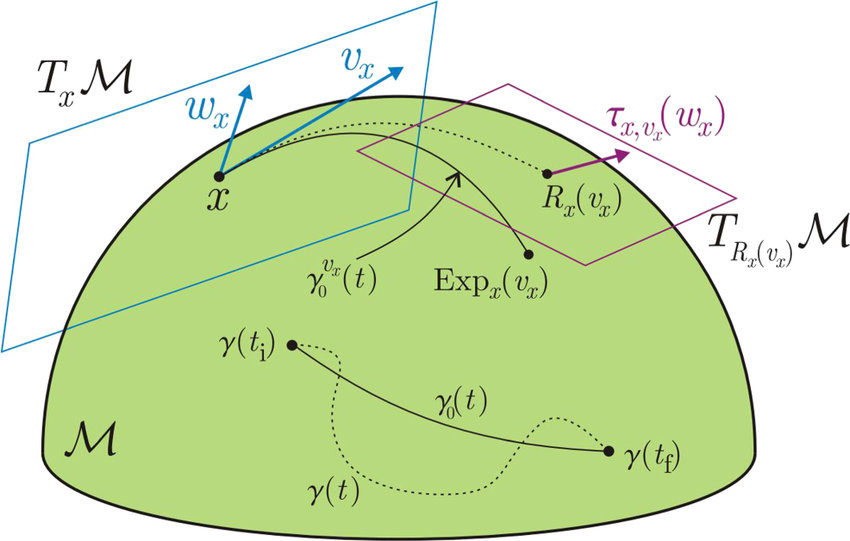
Definition 27. A second-order retraction $R$ on a Riemannian manifold $\mathcal{M}$ is a retraction such that, for all $x\in \mathcal{M}$ and all $v \in \operatorname{T}_{x}{\mathcal{M}}$, the curve $c(t) = R_x(tv)$ has zero acceleration at $t = 0$, that is, $c^{\prime\prime}(0) = 0$.
Proposition 28. Consider a Riemannian manifold $M$ equipped with any retraction $R$, and a smooth function $f: M \to \mathbb{R}$. If $x$ is a critical point of $f$ (that is, if $\mathrm{grad}f(x) = 0$), then
$$f(R_x(s)) = f(x) + \frac{1}{2} \langle \mathrm{Hess}f(x)[s], s \rangle _x + O(\|s\|_x^3).$$Also, if $R$ is a second-order retraction, then for all points $x \in M$ we have
$$f(R_x(s)) = f(x) + \langle \mathrm{grad}f(x), s \rangle _x + \frac{1}{2} \langle \mathrm{Hess}f(x)[s], s \rangle _x + O(\|s\|_x^3).$$Proposition 29. If the retraction is second order or if $\operatorname{grad} f(x) = 0$, then
$$\operatorname{Hess} f(x) = \operatorname{Hess} (f \circ R_x)(0),$$where the right-hand side is the Hessian of $f \circ R_x : \operatorname{T} _{x}{\mathcal{M}} \to \mathbb{R}$ at $0 \in \operatorname{T} _{x}{\mathcal{M}}$. The latter is a “classical” Hessian since $\operatorname{T} _{x}{\mathcal{M}}$ is a Euclidean space.